National Clinical Terminology Service Registration Terms
User Registration
Individual
Choose this option if you are an individual and wish to use the NCTS resources for your own personal use, or you are a member of an Organisation that has already registered to use the NCTS.
Organisation
Choose this option if you are an individual and wish to use the NCTS resources for your own personal use, or you are a member of an Organisation that has already registered to use the NCTS.
By registering to access and/or download the Registration Content, you agree to be bound by the Registration Terms outlined below. All registered users will be required to answer a short Statement of Usage survey annually each June as a condition of continued access to the Registration Content.
These are the terms (Registration Terms) under which users can register on the National Clinical Terminology Service (NCTS) website found at www.healthterminologies.gov.au (Website) to access and download certain terminology products and tools (Registration Content). By registering to access and/or download the Registration Content, you agree to be bound by these Registration Terms. The Australian Digital Health Agency (the Agency) may amend these Registration Terms from time to time and without notice to you. If you continue to access the Registration Content you are deemed to have accepted the Registration Terms, as amended.
Other parts of the Website may have specific terms and conditions of use which apply in addition to these Registration Terms, and by accessing those parts of the Website, you also agree to those additional terms and conditions of use.
Individual
By registering to access and/or download the Registration Content, you will be able to access and/or download (where applicable) the Registration Content which contains Agency developed products and third party developed products from time to time, including:
the Australian National Terminology release comprising the International Release of SNOMED CT® 1 together with the Australian national extensions (e.g. SNOMED CT AU) and any Australian national derivatives (e.g. Australian Medicines Terminology); some third party terminology products licensed to the Agency by third parties;
This release is maintained against the May 2026 SNOMED CT International Edition.
The LOINC release version available from the National Terminology Server is version 2.82.
Identifying the version of this release of SNOMED CT-AU
When using codes from this release (for example, in clinical documents, maps, or terminology servers) the following string should be used to identify the version of this release: http://snomed.info/sct/32506021000036107/version/20260531
Inclusions
This release contains the following content, accessible from the NCTS website:
Status
Name and version
New
SNOMED CT-AU 31 May 2026 (RF2 FULL)
New
SNOMED CT-AU31 May 2026(RF2 SNAPSHOT)
New
SNOMED CT-AU 31 May 2026 (RF2 ALL)
New
SNOMED CT-AU Release Note 31 May 2026 (this document)
New
AMT CSV 20260531
New
AMT TSV 20260531
New
FHIR Value Sets v20260531
New
TSV format reference sets v20260531
Change summary
This section summarises the changes in this release and provides notice about planned future work. Changes made to resolve data issues will be listed if the potential impact on systems or patient care exceeds a threshold determined by an internal risk matrix assessment.
In addition to the modelling of new products, based on the 1 June 2026 PBS and RPBS schedule, a number of other products have been modelled in this release.
AMT
Requested Content
Requested submission for new medicinal cannabis concepts have been added in this release from various sponsors.
SCT-AU
Requested Content
Request submissions for new concepts and descriptions have been added in this release from HMB project, Queensland Health and Healthdirect.
Reference Set
Requested Content
Request submission for new reference sets from Sparked.
Future changes
Terminology
Category/ID
Description
SCT-AU
EDRS
With the release of the new Australian emergency department reference set as of January 2019, there are plans to deprecate the original Emergency Department Reference (EDRS) set in a forthcoming release. Current users of the EDRS will be consulted prior to confirming the deprecation date.
The core Concept, Description and Relationship files have been updated to include the May 2026 International SNOMED CT Release.
Consequently, all reference sets provided in the previous release have been updated accordingly. Specific content developments and improvements have been inherited from the May 2026 SNOMED CT International Release.
News and events /
RCPA – Pathology Terminology and Information Models and draft FHIR reference set resources 31 May 2026 release note
RCPA – Pathology Terminology and Information Models and draft FHIR reference set resources 31 May 2026 release note
May 20, 2026
Release summary: RCPA – Pathology Terminology and Information Models and draft FHIR reference set resources for RCPA release bundle v20260531 (DH-4384:2026)
This end product contains terminology and information model resources and draft FHIR reference set resources, developed and owned by the Royal College of Pathologists of Australasia (RCPA).[1]
These resources have been developed as part of the National Pathology Terminology and Information Standardisation Plan. More information about development and reviews can be accessed on the RCPA website.
Please note: these resources are now labelled as SPIA (Standards for Pathology Informatics in Australia), having previously been known as APUTS (Australian Pathology Units and Terminology Standards).
Disclaimer
The Australian Digital Health Agency (the Agency) provides the information in this release note (“Information”) available in good faith but on an “as is” basis without any representation or warranty as to its accuracy or completeness. The Agency also makes this end product (“Product”) available in accordance with the RCPA Pathology Terminology and Information Models Terms of Use v1.0, which can be found in the same package where you downloaded this release note. The Agency does not accept any responsibility and, to the extent permitted by law, excludes all liability in connection with any use or inability to use the Information or the Product. As the Information or Product is of a general nature only, it is up to any person using or wishing to use the Information or Product to ensure that they are accurate, complete and suitable for the circumstances of their use.
[1] The copyright for the terminology and information model resources is owned by The Royal College of Pathologists of Australasia (RCPA).
Audience
The audience for this end product includes those involved in pathology informatics standards development, the implementation of standards related to terminology, information and units by pathology practices and their customers, and structured reporting of carcinoma.
Release rationale
This package contains an updated version of the Requesting Pathology Terminology Reference Set and draft Structured Pathology Reporting of Cancer FHIR Reference Sets.
This release includes:
Status
Name
Description
Updated
RCPA SPIA Haematology Transfusion Reporting Terminology Reference Set May 2026
Provides a set of terms for reporting haematology in Australia, along with their associated codes and preferred units. Specifically, it provides Preferred Terms and units for reporting haematology test results, which can be used in the electronic communication of a pathology report.
Updated
RCPA SPIA Microbiology Subset of Organisms May 2025
Provides a set of terms for reporting microbiology organisms in Australia, along with their associated SNOMED CT codes. Specifically, it provides Preferred Terms for reporting microbiology test results, which can be used in the electronic communication of a pathology report.
Updated
RCPA SPIA Requesting Pathology Terminology May 2026
Provides a set of terms for requesting pathology in Australia, along with their associated SNOMED CT codes. It is intended to provide a request terminology reference set for the most commonly requested terms used in both public and private practice.
Updated
RCPA Top 50 Priority Tests for SPIA adoption May 2026
The Royal College of Pathologists of Australasia (RCPA) has been contracted by the Australian Digital Health Agency (ADHA) to collate pathology requesting data from a range of sources with the intent to develop a Priority Tests/panels for Standardised Pathology Informatics in Australia (SPIA) adoption which any laboratory can utilise as a starting point to begin the SPIA Implementation process. The details of how this data was sourced can be found here: https://www.rcpa.edu.au/Library/Practising-Pathology/PTIS/Top-50-Priority-Tests-Panels-for-SPIA-adoption
No Change
RCPA SPIA Chemical Pathology Reporting Terminology Reference Set February 2026
Provides a set of terms for reporting chemical pathology in Australia, along with their associated codes and preferred units. Specifically, it provides Preferred Terms and units for reporting chemical pathology test results, which can be used in the electronic communication of a pathology report. Additionally, this reference set provides implementation guidance on whether it is safe for tests from different laboratories or from the same laboratory over time to be reported on the same line in a cumulative report or as points in the same line on a graph.
No Change
RCPA SPIA Requesting Allergens Terminology Reference Set February 2026
Provides a set of terms for requesting allergens in Australia, along with their associated SNOMED CT codes. It is intended to enable the requesting of the majority of allergens commonly found in Australia, with the specific terms and codes enhancing the context of information provided to laboratory staff and clinicians.
No Change
RCPA SPIA Anatomical Pathology Gastric Cancer Report Information Model Terminology December 2025
Provides a set of terms for gastric cancer reporting in Australia, along with their associated codes. Specifically, it provides a structured report model and Preferred Terms for reporting on gastric cancer, which can be used in the electronic communication of a pathology report.
No Change
RCPA SPIA Anatomical Pathology Prostate Cancer Radical Information Model Terminology December 2025
Provides a set of terms for prostate cancer (radical prostatectomy) reporting in Australia, along with their associated codes. Specifically, it provides a structured report model and Preferred Terms for reporting on prostate cancer (radical prostatectomy), which can be used in the electronic communication of a pathology report.
No Change
RCPA SPIA Andrology Information Model December 2025
Provides a set of terms for reporting andrology tests in Australia, along with their associated codes. Specifically, it provides a structured report model and Preferred Terms for reporting andrology test results, which can be used in the electronic communication of a pathology report.
No Change
RCPA SPIA Chemical Pathology Blood Gases Terminology Reference Set December 2025
Provides a set of terms for requesting and reporting blood gases in Australia, along with their associated codes. Specifically, it provides terms for requesting and reporting blood gases from 8 different specimens, which can be used in the electronic communication of a pathology report.
No Change
RCPA SPIA Cytopathology Information Model Terminology December 2025
Provides a set of terms for reporting cytopathology in Australia, along with their associated codes. Specifically, it provides a structured report model and Preferred Terms for reporting cytopathology test results, which can be used in the electronic communication of a pathology report.
No Change
RCPA SPIA Genetic Pathology Information Model Terminology December 2025
Provides a set of terms for genetic reporting in Australia, along with their associated codes. Specifically, it provides a structured report model and Preferred Terms for reporting genetics, which can be used in the electronic communication of a pathology report.
No Change
RCPA SPIA Immunopathology Reporting Terminology Reference Set December 2025
Provides a set of terms for reporting immunopathology in Australia, along with their associated codes and preferred units. Specifically, it provides Preferred Terms and units for reporting immunopathology test results, which can be used in the electronic communication of a pathology report.
No Change
RCPA SPIA Microbiology Serology Molecular Reporting Terminology Reference Set December 2025
Provides a set of terms for reporting microbiology serology and molecular tests in Australia, along with their associated codes and preferred units. Specifically, it provides Preferred Terms and units for reporting microbiology serology and molecular test results, which can be used in the electronic communication of a pathology report.
No Change
RCPA SPIA Preferred Units Table December 2025
Provides a list of preferred units and UCUM terms used commonly in pathology reporting. It was created to provide a convenient file of preferred units to assist with implementations.
No Change
RCPA SPIA Anatomical Pathology Cervical Cancer FHIR mapping December 2024
Provides a set of terms for reporting Cervical cancer in Australia, along with their associated codes. Specifically, it provides a structured report model and Preferred Terms for surgical pathology reporting, which can be used in the electronic communication of a pathology report.
No Change
RCPA SPIA Anatomical Pathology Colorectal Cancer FHIR mapping December 2024
Provides a set of terms for reporting Colorectal cancer in Australia, along with their associated codes. Specifically, it provides a structured report model and Preferred Terms for surgical pathology reporting, which can be used in the electronic communication of a pathology report.
No Change
RCPA SPIA Anatomical Pathology Endometrial Cancer FHIR mapping December 2024
Provides a set of terms for reporting Endometrial cancer in Australia, along with their associated codes. Specifically, it provides a structured report model and Preferred Terms for surgical pathology reporting, which can be used in the electronic communication of a pathology report.
No Change
RCPA SPIA Anatomical Pathology Ovary Fallopian Tube Cancer FHIR mapping December 2024
Provides a set of terms for reporting Ovarian or Fallopian tube cancer in Australia, along with their associated codes. Specifically, it provides a structured report model and Preferred Terms for surgical pathology reporting, which can be used in the electronic communication of a pathology report.
No Change
RCPA SPIA Anatomical Pathology Polypectomy FHIR mapping December 2024
Provides a set of terms for reporting Polypectomies in Australia, along with their associated codes. Specifically, it provides a structured report model and Preferred Terms for surgical pathology reporting, which can be used in the electronic communication of a pathology report.
No Change
RCPA SPIA Anatomical Pathology Generic Surgical Pathology Report Information Model Terminology December 2024
Provides a set of terms for reporting surgical pathology in Australia, along with their associated codes. Specifically, it provides a structured report model and Preferred Terms for surgical pathology reporting, which can be used in the electronic communication of a pathology report.
No Change
RCPA SPIA Chemical Pathology Harmonised Reference Intervals tables December 2024
Provides a list of Harmonised Reference intervals (HRI) for 18 common chemical pathology analytes with separate ranges applied to paediatric and adult samples. The HRIs were developed to reduce confusion surrounding inconsistencies associated with flagging of abnormal results and the comparison of results from various laboratories within Australia. The HRI can be used in the electronic communication of a pathology report.
No Change
RCPA SPIA Urine Microbiology Information Model Terminology and Salmonella Information Model Terminology December 2024
Provides a mindmap overview of the RCPA model for microbiology reports where salmonella is identified, including referral to reference laboratory, and notifications to public health registries. This also contains a mindmap overview of the RCPA model for reporting the results of Urine microscopy, culture and sensitivities. It details the relevant data elements and their LOINC codes to be used, along with any specific result codes.
Recommended reading
The NCTS document library provides an extensive list of introductory and technical documentation to support your use of terminology products and tools. You can find out more by visiting Learn on our website.
Key guidance includes:
Introduction to SNOMED CT-AU presentation and webinar
SNOMED CT‑AU Australian Technical Implementation Guide
The core Concept, Description and Relationship files have been updated to include the April 2026 International SNOMED CT Release.
Consequently, all reference sets provided in the previous release have been updated accordingly. Specific content developments and improvements have been inherited from the April 2026 SNOMED CT International Release.
Updated resource
The AMT Editorial and Naming Rules v4.1 is now updated to include the Medicinal Cannabis model.
If you have any questions or concerns feel free to contact us by emailing help@digitalhealth.gov.au.
This release is maintained against the April 2026 SNOMED CT International Edition.
The LOINC release version available from the National Terminology Server is version 2.82.
Identifying the version of this release of SNOMED CT-AU
When using codes from this release (for example, in clinical documents, maps, or terminology servers) the following string should be used to identify the version of this release: http://snomed.info/sct/32506021000036107/version/20260430
Inclusions
This release contains the following content, accessible from the NCTS website:
Status
Name and version
New
SNOMED CT-AU 30 April 2026 (RF2 FULL)
New
SNOMED CT-AU30 April 2026(RF2 SNAPSHOT)
New
SNOMED CT-AU 30 April 2026 (RF2 ALL)
New
SNOMED CT-AU Release Note 30 April 2026 (this document)
New
AMT CSV 20260430
New
AMT TSV 20260430
New
FHIR Code Systems v20260430
New
FHIR Value Sets v20260430
New
TSV format reference sets v20260430
Change summary
This section summarises the changes in this release and provides notice about planned future work. Changes made to resolve data issues will be listed if the potential impact on systems or patient care exceeds a threshold determined by an internal risk matrix assessment.
In addition to the modelling of new products, based on the 1 May 2026 PBS and RPBS schedule, a number of other products have been modelled in this release.
AMT
Content quality improvement
Remediation work is completed to align existing medicinal cannabis concepts with a standardised terminology approach informed by the NCTS Medicinal Cannabis Terminology User Group consultations.
SCT-AU
Requested Content
Request submissions for new concepts and descriptions have been added in this release from HMB project.
Reference Set
Requested Content
Request submission for new reference sets from Sparked.
Future changes
Terminology
Category/ID
Description
SCT-AU
EDRS
With the release of the new Australian emergency department reference set as of January 2019, there are plans to deprecate the original Emergency Department Reference (EDRS) set in a forthcoming release. Current users of the EDRS will be consulted prior to confirming the deprecation date.
Upcoming releases
The upcoming release schedule will be as follows:
Wednesday 27 May 2026
Friday 26 June 2026
Wednesday 29 July 2026
News and events /
NCTS Communique: Change to the Modelling of Medicinal Cannabis Products in the AMT
NCTS Communique: Change to the Modelling of Medicinal Cannabis Products in the AMT
Apr 16, 2026
Following updates to the Australian Medicines Terminology (AMT) Editorial and Naming Rules, the modelling of medicinal cannabis will be revised, which may result in changes to concept descriptions, and the depiction of active ingredients and strength representation within the terminology.
Who will be impacted and what do I need to know?
The primary audience for this communique is software vendors and implementers.
The updated AMT Editorial and Naming Rules will not model active ingredients where the strength is represented as an inequality and will consider the definition of an active ingredient for medicinal cannabis based on the Therapeutic Goods (Standard for Medicinal Cannabis) Order 2017 (TGO 93). Depending on vendor implementation of this update, clinical end users may experience changes to the display of medicinal cannabis products during medicine selection.
The TGO 93 defines an active ingredient as follows:
Tetrahydrocannabinol (THC), including corresponding acids in quantities equal to or greater than 1% w/w or w/v of the product.
Cannabidiol (CBD) and any other cannabinoids, including corresponding acids, equal to or greater than 2% w/w or w/v of the product.
As such, cannabinoid substances expressed as inequalities that are at or below the TGO 93 threshold will no longer be modelled. Additionally, cannabinoid substances with strengths represented as inequalities above the TGO 93 threshold will not be eligible for inclusion in the AMT.
Table 1 displays examples of changes to modelling and AMT eligibility based on the updated AMT Editorial and Naming Rules.
Table 1: Example of changes to Medicinal Cannabis modelling
Strength represented as:
Current Modelling of Containerised Branded Clinical Drug Package
Future Modelling of Containerised Branded Clinical Drug Package
An inequality at or below TGO93 thresholds
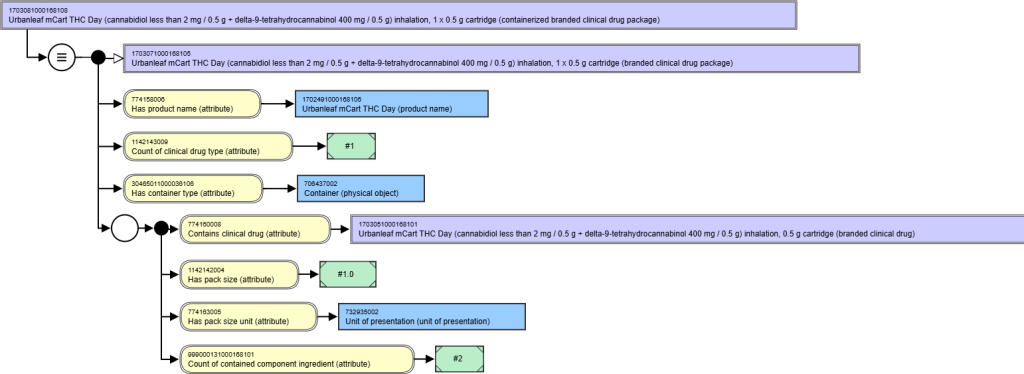
Inequality is modelled Example: Urbanleaf mCart THC Day (cannabidiol less than 2 mg / 0.5 g + delta-9-tetrahydrocannabinol 400 mg / 0.5 g) inhalation, 1 x 0.5 g cartridge (containerised branded clinical drug package) (containerised branded clinical drug package) (Figure 1)
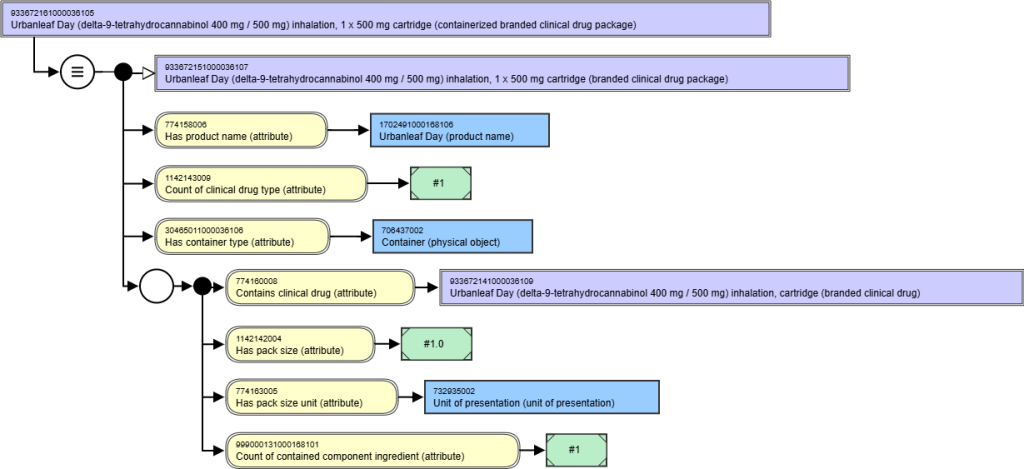
Inequality is NOT modelled Example: Urbanleaf mCart THC Day (delta-9-tetrahydrocannabinol 400 mg / 0.5 g) inhalation, 1 x 0.5 g cartridge (containerised branded clinical drug package) (Figure 2)
An inequality above TGO93 thresholds
Currently in AMT for already released content. Modelling for existing AMT concepts will not change.
Prospective only for new content request submissions New medicinal cannabis concepts with an inequality above TGO93 thresholds will NOT be eligible to be modelled using the updated approach. Existing concepts will NOT change Example: Urbanleaf mCart THC Night (cannabidiol less than 40 mg / 1 g + delta-9-tetrahydrocannabinol 800 mg / 1 g) inhalation, 1 x 1 g cartridge (containerised branded clinical drug package)
A concrete value (i.e. the strength is NOT an inequality)
Concrete values are modelled Example: Grandiosa Kosher Kush (cannabigerol 14.2 mg / 1 g + delta-9-tetrahydrocannabinol 220 mg / 1 g) bud, 10 g, jar (containerised branded clinical drug package)
No change to modelling Example: Grandiosa Kosher Kush (cannabigerol 14.2 mg / 1 g + delta-9-tetrahydrocannabinol 220 mg / 1 g) bud, 10 g, jar (containerised branded clinical drug package)
As a result of the update to the AMT model, some medicinal cannabis legacy content in the AMT will not be amended to fit the model and will thus remain unchanged.
Following vendor implementation of AMTv4, the primary clinical risk is the potential for incorrect selection of medicinal cannabis products which may occur due to:
Values used to identify a product may no longer be visible to the healthcare provider, making it harder to distinguish between products
Inconsistencies between the onscreen display of the product and sponsor product detail
Products that previously looked different may now appear more similar on screen.
Overall, the incorrect selection of medicinal products can lead to a supply of an inappropriate cannabis formulation to a consumer. The incorrect formulation may be an omission of a required cannabinoid resulting in sub-therapeutic treatment while an unintended increase or addition of a cannabinoid substance may lead to unmonitored adverse effects. Errors involving THC pose greater clinical consequences due to its psychoactive properties
What do I need to do?
Software vendors and implementers must consider how changes to AMT Editorial and Naming Rules will impact the clinical users of their systems. To mitigate the risk of selection errors, we strongly recommend software vendors and implementers:
Confirm the impact of updated AMT modelling on medicinal cannabis product displays into your systems
Communicate confirmed changes to the display of medicinal cannabis on your software to clinical end users
Validate display logic and mapping rules
Conduct regression testing across relevant workflows to ensure updates do not break existing functionalities
Provide guidance/training to end users
Implement monitoring and feedback channels.
Figure 1: Current containerised braded clinical drug package modelling for a vape product.
News and events /
RCPA – Pathology Terminology and Information Models and draft FHIR reference set resources 31 March 2026 release note
RCPA – Pathology Terminology and Information Models and draft FHIR reference set resources 31 March 2026 release note
Mar 23, 2026
Release summary: RCPA – Pathology Terminology and Information Models and draft FHIR reference set resources for RCPA release bundle v20260331 (EP-4304:2026)
This end product contains terminology and information model resources and draft FHIR reference set resources, developed and owned by the Royal College of Pathologists of Australasia (RCPA).[1]
These resources have been developed as part of the National Pathology Terminology and Information Standardisation Plan. More information about development and reviews can be accessed on the RCPA website.
Please note: these resources are now labelled as SPIA (Standards for Pathology Informatics in Australia), having previously been known as APUTS (Australian Pathology Units and Terminology Standards).
Disclaimer
The Australian Digital Health Agency (the Agency) provides the information in this release note (“Information”) available in good faith but on an “as is” basis without any representation or warranty as to its accuracy or completeness. The Agency also makes this end product (“Product”) available in accordance with the RCPA Pathology Terminology and Information Models Terms of Use v1.0, which can be found in the same package where you downloaded this release note. The Agency does not accept any responsibility and, to the extent permitted by law, excludes all liability in connection with any use or inability to use the Information or the Product. As the Information or Product is of a general nature only, it is up to any person using or wishing to use the Information or Product to ensure that they are accurate, complete and suitable for the circumstances of their use.
[1] The copyright for the terminology and information model resources is owned by The Royal College of Pathologists of Australasia (RCPA).
Audience
The audience for this end product includes those involved in pathology informatics standards development, the implementation of standards related to terminology, information and units by pathology practices and their customers, and structured reporting of carcinoma.
Release rationale
This package contains an updated version of the Requesting Pathology Terminology Reference Set and draft Structured Pathology Reporting of Cancer FHIR Reference Sets.
This release includes:
Updated
RCPA SPIA Requesting Pathology Terminology March 2026
Provides a set of terms for requesting pathology in Australia, along with their associated SNOMED CT codes. It is intended to provide a request terminology reference set for the most commonly requested terms used in both public and private practice.
No Change
RCPA SPIA Chemical Pathology Reporting Terminology Reference Set February 2026
Provides a set of terms for reporting chemical pathology in Australia, along with their associated codes and preferred units. Specifically, it provides Preferred Terms and units for reporting chemical pathology test results, which can be used in the electronic communication of a pathology report. Additionally, this reference set provides implementation guidance on whether it is safe for tests from different laboratories or from the same laboratory over time to be reported on the same line in a cumulative report or as points in the same line on a graph.
No Change
RCPA SPIA Haematology Transfusion Reporting Terminology Reference Set February 2026
Provides a set of terms for reporting haematology in Australia, along with their associated codes and preferred units. Specifically, it provides Preferred Terms and units for reporting haematology test results, which can be used in the electronic communication of a pathology report.
No Change
RCPA SPIA Requesting Allergens Terminology Reference Set February 2026
Provides a set of terms for requesting allergens in Australia, along with their associated SNOMED CT codes. It is intended to enable the requesting of the majority of allergens commonly found in Australia, with the specific terms and codes enhancing the context of information provided to laboratory staff and clinicians.
No Change
RCPA SPIA Anatomical Pathology Gastric Cancer Report Information Model Terminology December 2025
Provides a set of terms for gastric cancer reporting in Australia, along with their associated codes. Specifically, it provides a structured report model and Preferred Terms for reporting on gastric cancer, which can be used in the electronic communication of a pathology report.
No Change
RCPA SPIA Anatomical Pathology Prostate Cancer Radical Information Model Terminology December 2025
Provides a set of terms for prostate cancer (radical prostatectomy) reporting in Australia, along with their associated codes. Specifically, it provides a structured report model and Preferred Terms for reporting on prostate cancer (radical prostatectomy), which can be used in the electronic communication of a pathology report.
No Change
RCPA SPIA Andrology Information Model December 2025
Provides a set of terms for reporting andrology tests in Australia, along with their associated codes. Specifically, it provides a structured report model and Preferred Terms for reporting andrology test results, which can be used in the electronic communication of a pathology report.
No Change
RCPA SPIA Chemical Pathology Blood Gases Terminology Reference Set December 2025
Provides a set of terms for requesting and reporting blood gases in Australia, along with their associated codes. Specifically, it provides terms for requesting and reporting blood gases from 8 different specimens, which can be used in the electronic communication of a pathology report.
No Change
RCPA SPIA Cytopathology Information Model Terminology December 2025
Provides a set of terms for reporting cytopathology in Australia, along with their associated codes. Specifically, it provides a structured report model and Preferred Terms for reporting cytopathology test results, which can be used in the electronic communication of a pathology report.
No Change
RCPA SPIA Genetic Pathology Information Model Terminology December 2025
Provides a set of terms for genetic reporting in Australia, along with their associated codes. Specifically, it provides a structured report model and Preferred Terms for reporting genetics, which can be used in the electronic communication of a pathology report.
No Change
RCPA SPIA Immunopathology Reporting Terminology Reference Set December 2025
Provides a set of terms for reporting immunopathology in Australia, along with their associated codes and preferred units. Specifically, it provides Preferred Terms and units for reporting immunopathology test results, which can be used in the electronic communication of a pathology report.
No Change
RCPA SPIA Microbiology Serology Molecular Reporting Terminology Reference Set December 2025
Provides a set of terms for reporting microbiology serology and molecular tests in Australia, along with their associated codes and preferred units. Specifically, it provides Preferred Terms and units for reporting microbiology serology and molecular test results, which can be used in the electronic communication of a pathology report.
No Change
RCPA SPIA Microbiology Subset of Organisms December 2025
Provides a set of terms for reporting microbiology organisms in Australia, along with their associated SNOMED CT codes. Specifically, it provides Preferred Terms for reporting microbiology test results, which can be used in the electronic communication of a pathology report.
No Change
RCPA SPIA Preferred Units Table December 2025
Provides a list of preferred units and UCUM terms used commonly in pathology reporting. It was created to provide a convenient file of preferred units to assist with implementations.
No Change
RCPA Top 50 Priority Tests for SPIA adoption December 2024
The Royal College of Pathologists of Australasia (RCPA) has been contracted by the Australian Digital Health Agency (ADHA) to collate pathology requesting data from a range of sources with the intent to develop a Priority Tests/panels for Standardised Pathology Informatics in Australia (SPIA) adoption which any laboratory can utilise as a starting point to begin the SPIA Implementation process. The details of how this data was sourced can be found here: https://www.rcpa.edu.au/Library/Practising-Pathology/PTIS/Top-50-Priority-Tests-Panels-for-SPIA-adoption
No Change
RCPA SPIA Anatomical Pathology Cervical Cancer FHIR mapping December 2024
Provides a set of terms for reporting Cervical cancer in Australia, along with their associated codes. Specifically, it provides a structured report model and Preferred Terms for surgical pathology reporting, which can be used in the electronic communication of a pathology report.
No Change
RCPA SPIA Anatomical Pathology Colorectal Cancer FHIR mapping December 2024
Provides a set of terms for reporting Colorectal cancer in Australia, along with their associated codes. Specifically, it provides a structured report model and Preferred Terms for surgical pathology reporting, which can be used in the electronic communication of a pathology report.
No Change
RCPA SPIA Anatomical Pathology Endometrial Cancer FHIR mapping December 2024
Provides a set of terms for reporting Endometrial cancer in Australia, along with their associated codes. Specifically, it provides a structured report model and Preferred Terms for surgical pathology reporting, which can be used in the electronic communication of a pathology report.
No Change
RCPA SPIA Anatomical Pathology Ovary Fallopian Tube Cancer FHIR mapping December 2024
Provides a set of terms for reporting Ovarian or Fallopian tube cancer in Australia, along with their associated codes. Specifically, it provides a structured report model and Preferred Terms for surgical pathology reporting, which can be used in the electronic communication of a pathology report.
No Change
RCPA SPIA Anatomical Pathology Polypectomy FHIR mapping December 2024
Provides a set of terms for reporting Polypectomies in Australia, along with their associated codes. Specifically, it provides a structured report model and Preferred Terms for surgical pathology reporting, which can be used in the electronic communication of a pathology report.
No Change
RCPA SPIA Anatomical Pathology Generic Surgical Pathology Report Information Model Terminology December 2024
Provides a set of terms for reporting surgical pathology in Australia, along with their associated codes. Specifically, it provides a structured report model and Preferred Terms for surgical pathology reporting, which can be used in the electronic communication of a pathology report.
No Change
RCPA SPIA Chemical Pathology Harmonised Reference Intervals tables December 2024
Provides a list of Harmonised Reference intervals (HRI) for 18 common chemical pathology analytes with separate ranges applied to paediatric and adult samples. The HRIs were developed to reduce confusion surrounding inconsistencies associated with flagging of abnormal results and the comparison of results from various laboratories within Australia. The HRI can be used in the electronic communication of a pathology report.
No Change
RCPA SPIA Urine Microbiology Information Model Terminology and Salmonella Information Model Terminology December 2024
Provides a mindmap overview of the RCPA model for microbiology reports where salmonella is identified, including referral to reference laboratory, and notifications to public health registries. This also contains a mindmap overview of the RCPA model for reporting the results of Urine microscopy, culture and sensitivities. It details the relevant data elements and their LOINC codes to be used, along with any specific result codes.
Recommended reading
The NCTS document library provides an extensive list of introductory and technical documentation to support your use of terminology products and tools. You can find out more by visiting Learn on our website.
Key guidance includes:
Introduction to SNOMED CT-AU presentation and webinar
SNOMED CT‑AU Australian Technical Implementation Guide
This release is maintained against the March 2026 SNOMED CT International Edition.
The LOINC release version available from the National Terminology Server is version 2.82.
Identifying the version of this release of SNOMED CT-AU
When using codes from this release (for example, in clinical documents, maps, or terminology servers) the following string should be used to identify the version of this release: http://snomed.info/sct/32506021000036107/version/20260331
Inclusions
This release contains the following content, accessible from the NCTS website:
Status
Name and version
New
SNOMED CT-AU 31 March 2026 (RF2 FULL)
New
SNOMED CT-AU31 March 2026(RF2 SNAPSHOT)
New
SNOMED CT-AU 31 March 2026 (RF2 ALL)
New
SNOMED CT-AU Release Note 31 March 2026 (this document)
New
AMT CSV 20260331
New
AMT TSV 20260331
New
FHIR Code Systems v20260331
New
FHIR Value Sets v20260331
New
TSV format reference sets v20260331
Change summary
This section summarises the changes in this release and provides notice about planned future work. Changes made to resolve data issues will be listed if the potential impact on systems or patient care exceeds a threshold determined by an internal risk matrix assessment.
In addition to the modelling of new products, based on the 1 April 2026 PBS and RPBS schedule, a number of other products have been modelled in this release.
SCT-AU
Requested Content
Request submissions for new concepts and descriptions have been added in this release from Sparked.
Future changes
Terminology
Category/ID
Description
AMT
Content quality improvement
Remediation work is underway to align existing medicinal cannabis concepts with a standardised terminology approach informed by the NCTS Medicinal Cannabis Terminology User Group consultations. These updates will be incorporated into future releases.
SCT-AU
EDRS
With the release of the new Australian emergency department reference set as of January 2019, there are plans to deprecate the original Emergency Department Reference (EDRS) set in a forthcoming release. Current users of the EDRS will be consulted prior to confirming the deprecation date.
The core Concept, Description and Relationship files have been updated to include the March 2026 International SNOMED CT Release.
Consequently, all reference sets provided in the previous release have been updated accordingly. Specific content developments and improvements have been inherited from the March 2026 SNOMED CT International Release.
If you have any questions or concerns feel free to contact us by emailing help@digitalhealth.gov.au.